
Why The Super Mario Bros. Super Show! Still Matters to Retro Gaming Fans
Replay Bounty Admin | Sep 30, 2026
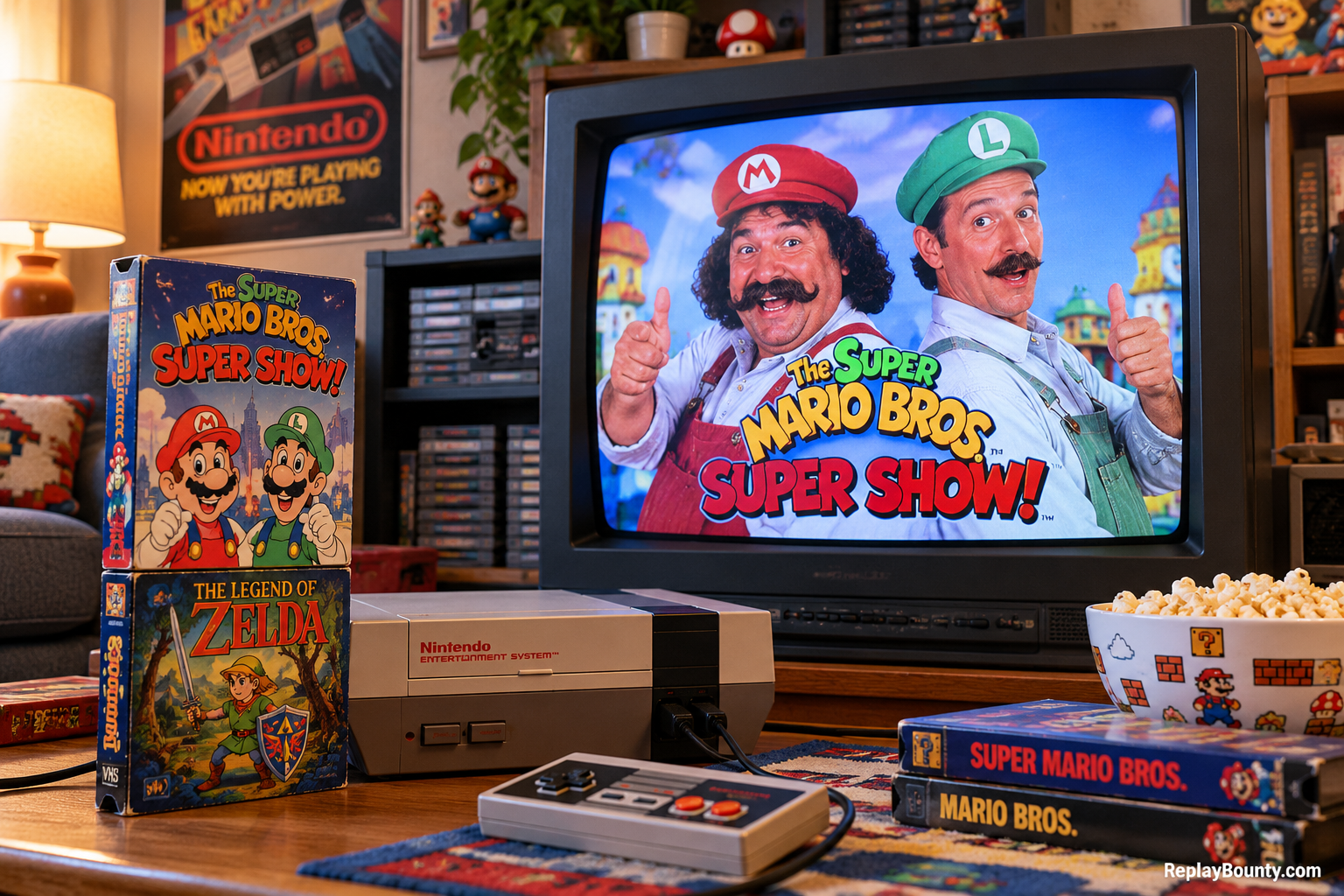
Long before video game adaptations became major Hollywood productions, Mario had already made the jump from the Nintendo Entertainment System to television.
In 1989, The Super Mario Bros. Super Show! brought Mario, Luigi, Princess Toadstool, Toad, King Koopa, and other familiar characters into homes across America through a combination of live-action comedy and animated adventures. The series aired in first-run syndication from September 4 through December 1, 1989. Captain Lou Albano played Mario, while Danny Wells portrayed Luigi. Both also provided the voices of their animated counterparts.
The show arrived during an important period in Nintendo history. The NES had become a major part of American gaming culture, but Mario's world was still much less defined than it is today. There were fewer games, fewer established characters, and far less official backstory. That gave the television series plenty of room to experiment.
And experiment it did.
The animated Mario stories were primarily inspired by Super Mario Bros. and Super Mario Bros. 2, but they rarely tried to simply recreate the games. Instead, Mario and his friends were dropped into parodies of movies, books, fairy tales, historical settings, and popular culture. Episodes could turn the Mushroom Kingdom into the Wild West, an underwater adventure, a medieval kingdom, or a monster-movie spoof.
That makes the series especially interesting today. It preserves a version of Mario from a time when Nintendo's characters were still being adapted very freely outside the games.
The live-action portions were even more unusual. Mario and Luigi were portrayed as plumbers living and working in Brooklyn, often receiving strange visitors and celebrity guests. Albano's exaggerated Mario became one of the earliest widely recognized live-action versions of the character in the United States.
For younger viewers at the time, the show helped make Mario feel like more than a sprite moving across an NES screen. He had a voice, a personality, a brother he constantly argued with, and an entire world that could exist outside the cartridge.
That may seem normal today, when video game characters appear in movies, television shows, toys, theme parks, and countless other forms of entertainment. In 1989, however, that kind of crossover was still much more unusual.
And Mario was not the only Nintendo hero to get the television treatment.
Right now on eBay
Live eBay listings are temporarily unavailable for this item. Please check back soon.
On Fridays, the animated Mario adventure was replaced by an episode based on The Legend of Zelda. Thirteen Zelda animated segments were produced as part of the show's original run. Link, Princess Zelda, Ganon, and the Triforce were all adapted for television, giving many NES players their first chance to see those characters regularly speaking and interacting outside the games.
The television version of Link was noticeably different from the quieter hero gamers would come to know in later Zelda titles. The cartoon gave him a much more outspoken personality, while Zelda was portrayed as an active participant in many of the adventures rather than simply someone waiting to be rescued.
Those differences are part of what makes the series fun to revisit. The show captures Nintendo franchises before decades of games had established strict expectations about how these characters should behave.
For retro gaming collectors, The Super Mario Bros. Super Show! also connects several different areas of collecting.
Someone who starts with NES cartridges may eventually become interested in Mario television memorabilia, VHS releases, DVDs, promotional material, magazines, toys, animation collectibles, or merchandise connected to the show. Zelda collectors can follow many of the same paths.
This is one reason retro gaming history extends far beyond consoles and cartridges. Games often created entire ecosystems of merchandise and entertainment around them, and those surrounding items can become collectibles in their own right.
The Super Show also serves as a reminder of how quickly Nintendo's characters were becoming part of mainstream culture during the NES era. Mario was no longer simply the character appearing in Super Mario Bros. He was becoming a recognizable entertainment personality.
The television experiment did not end there. Nintendo-related cartoons continued with The Adventures of Super Mario Bros. 3 in 1990 and Super Mario World in 1991, extending Mario's television presence into the early 1990s.
Today, the original Super Show can look strange compared with modern Nintendo productions. The animation, humor, character interpretations, and live-action segments all belong very clearly to their era.
That is also exactly what makes it worth preserving.
Retro gaming is not only about playing old games. It is about understanding the culture that surrounded them: the advertising, television programs, magazines, merchandise, toys, and strange experiments that helped turn game characters into cultural icons.
For Replay Bounty collectors exploring the Mario franchise, the NES era, or classic gaming television, The Super Mario Bros. Super Show! represents a very specific moment when Nintendo characters were beginning to escape the cartridge and become something much larger.
Sometimes gaming history is found inside a rare game box.
Sometimes it is hiding on an old VHS tape.