
Batman: The Caped Crusader — The Comic-Book Adventure Retro Gamers Overlooked
Replay Bounty Admin | Sep 30, 2026
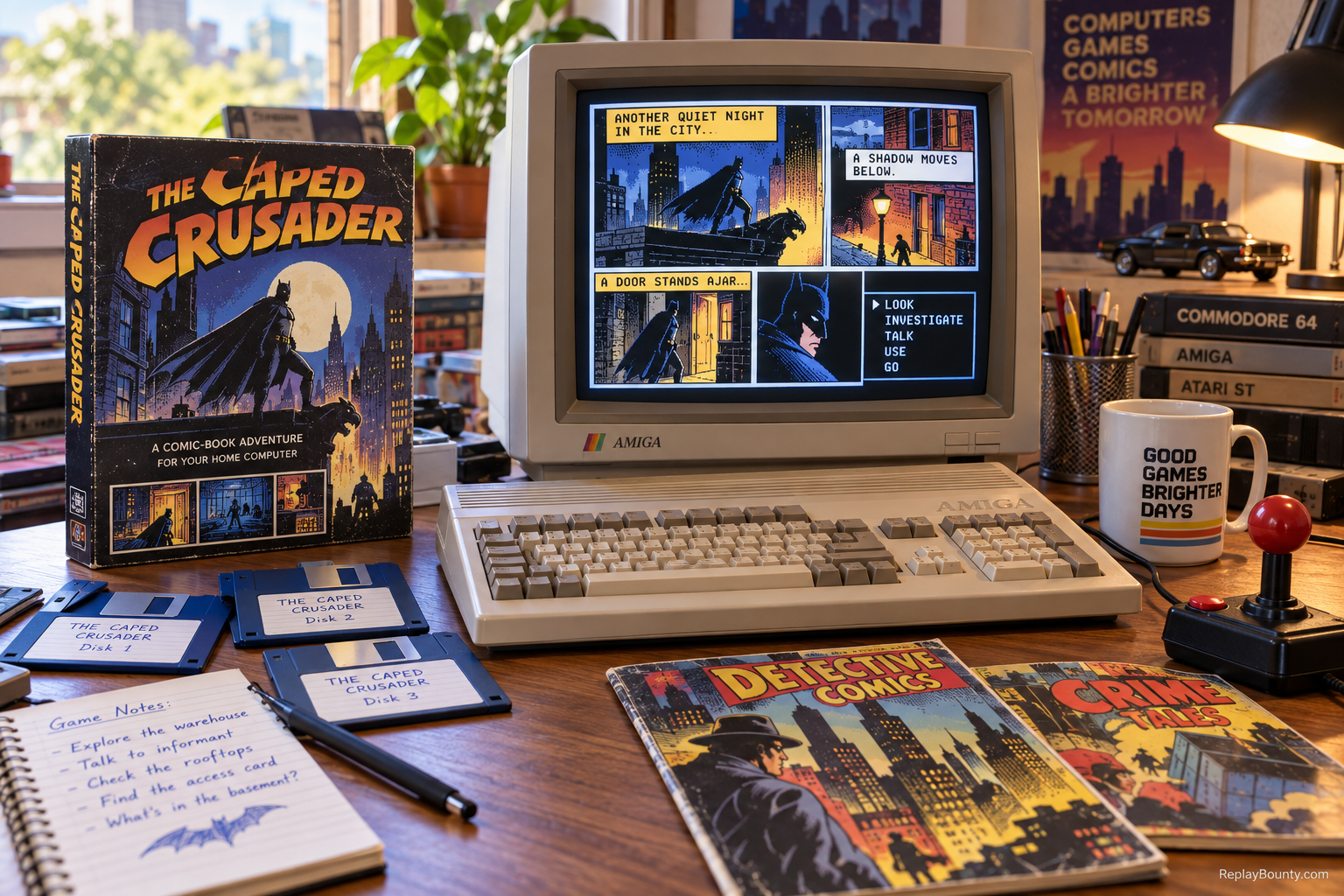
Long before Batman became a regular presence on modern consoles, one of his more unusual video game adventures was quietly doing something clever on home computers.
Released in 1988, Batman: The Caped Crusader arrived on systems including the Commodore 64, ZX Spectrum, Amstrad CPC, Amiga, and Atari ST, with additional versions following. Developed by Special FX Software, the game approached Batman very differently from the straightforward side-scrolling action games many players would later associate with licensed superheroes.
Instead, The Caped Crusader tried to make the game itself look and behave like a comic book.
As Batman moved from one location to another, new scenes appeared in panels layered across the screen. Previous locations remained visible behind them, creating the impression that the player was moving through the pages of an interactive comic. The Centre for Computing History describes this panel-based presentation as one of the game's defining innovations.
That visual idea still gives the game personality decades later.
Rather than simply running from left to right and punching enemies, players had to explore rooms, collect objects, examine clues, manage an inventory, and figure out where certain items should be used. Action was certainly part of the experience, but puzzle solving and exploration were just as important.
The game was actually divided into two separate adventures that could be tackled independently. In one, Batman faces the Penguin and investigates a scheme involving dangerous robotic penguins. In the other, the Joker has kidnapped Robin, forcing Batman into another investigation.
That structure makes the game feel almost like two comic-book issues packaged together.
It also captures a very different period in Batman gaming history. Today, Batman is strongly associated with sprawling 3D environments, cinematic combat, stealth mechanics, and darker interpretations of Gotham City. In the late 1980s, developers were still experimenting with what a Batman video game should actually be.
The Caped Crusader leaned heavily toward detective work.
That is fitting for a character who is supposed to be one of fiction's great detectives, but it is something many later Batman games would emphasize far less than combat.
Collectors exploring the larger Batman franchise on Replay Bounty can see just how many different directions developers and filmmakers have taken the character over the years. The franchise crosses games, movies, television, animation, and decades of changing technology, which makes these earlier experiments especially interesting to revisit.
Right now on eBay


One of the reasons Batman: The Caped Crusader can slip past modern retro gamers is its timing.
The game appeared shortly before Tim Burton's Batman movie dramatically increased Batman's visibility in 1989. Ocean Software would also release Batman: The Movie, a completely different game based on that film. That later title often receives more attention because of its association with the blockbuster movie, leaving The Caped Crusader sitting quietly between earlier Batman games and the huge wave of Batman popularity that followed.
For retro collectors, that makes the earlier game worth another look.
Its comic-panel interface is not merely decoration. Moving between locations causes panels to overlap like pages in a graphic novel, giving the game an identity that is immediately recognizable once you see it in motion. It is one of those design ideas that feels perfectly matched to the license.
The inventory system also gives the game more depth than someone might expect from a late-1980s superhero release. Players collect items and select actions for them while trying to work out how the different pieces of each adventure fit together. The C64 version, for example, uses an icon-driven inventory rather than turning every problem into another fight.
And because there are two separate scenarios, players are not simply following one long path from beginning to end.
That combination of exploration, puzzles, combat, inventory management, and comic-inspired presentation helps The Caped Crusader stand apart from many licensed games of its era.
It is also a good reminder that “hidden game” does not always mean an impossibly rare cartridge worth thousands of dollars.
Sometimes a hidden game is simply a title that has been overshadowed by something that came immediately before or after it.
Batman has appeared in so many games that smaller releases can easily disappear inside the franchise's enormous history. A collector searching only for the most famous Batman titles could pass over this one without realizing how unusual it was.
That is exactly where digging through older libraries becomes fun.
If you collect Commodore 64 software, boxed computer games, vintage Batman memorabilia, or early licensed superhero games, Replay Bounty's Batman: The Caped Crusader game page gives you a place to keep exploring the title, artwork, current marketplace listings, and collector information as it is added to the database.
And if this game sends you farther down the Batcave, the Batman franchise page connects it with other Batman games, movies, and television releases already cataloged on Replay Bounty.
More than thirty years later, Batman: The Caped Crusader remains an interesting example of developers trying to translate a comic-book superhero into a game without simply turning him into another action character.
It gave Batman puzzles to solve, clues to follow, objects to examine, villains to chase—and perhaps most importantly, a world that actually looked like it was being drawn one comic panel at a time.
For retro gamers who missed it, this is one Batman case that may still be worth reopening.