
Buying an Original Game Boy: What Collectors Should Check First
Replay Bounty Admin | Sep 25, 2026
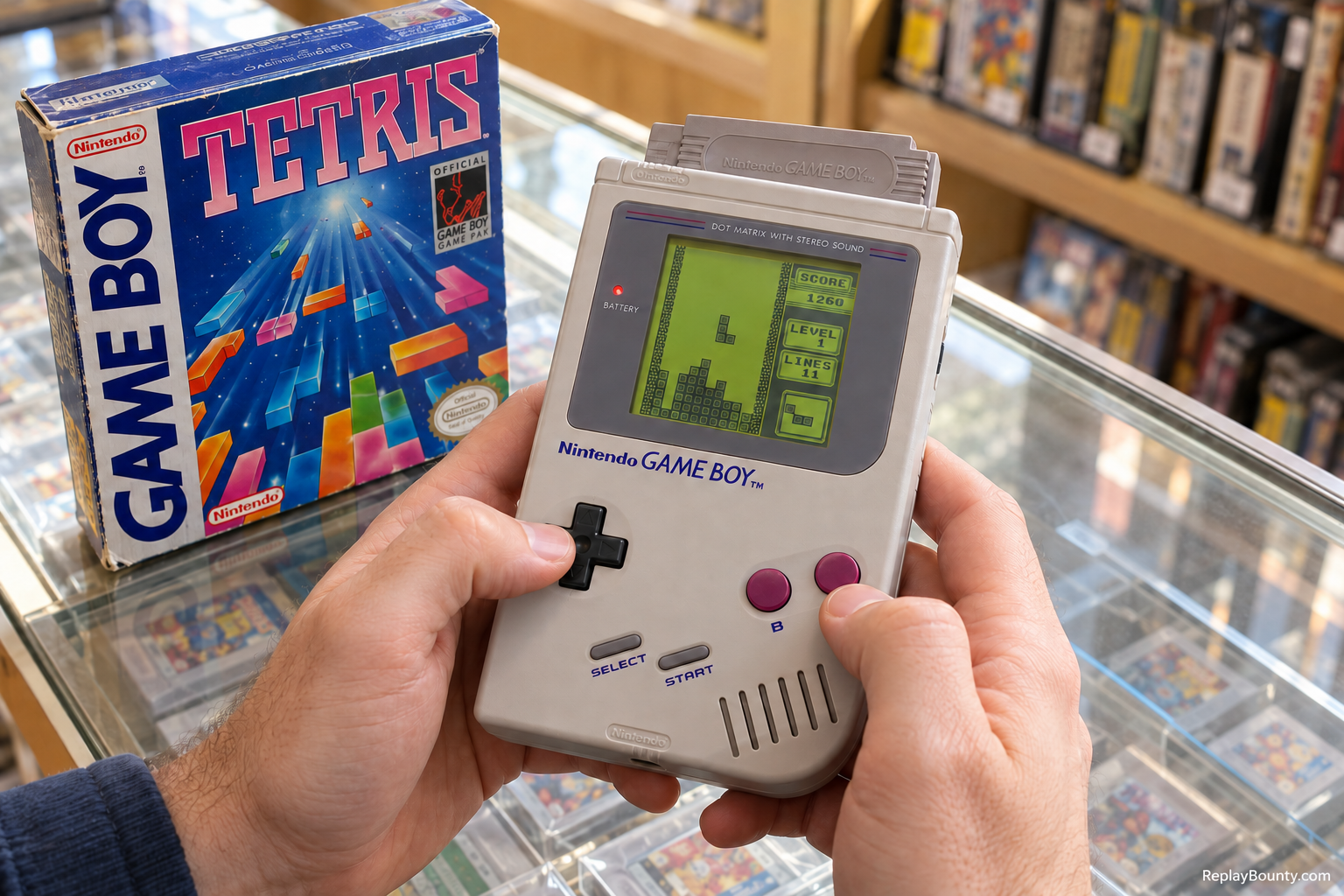
The original Game Boy has a way of making a small collection feel personal. Its familiar gray shell, simple controls, and library of pocket-sized games still invite you to pick it up and play. Nintendo introduced the handheld in Japan in 1989, and its early connection with Tetris helped introduce portable gaming to a broad audience.
If you are buying one today, start by deciding what you want from it. Are you looking for a clean original to display, a dependable system for regular play, or the Game Boy you remember carrying around as a kid? Those goals can lead to different choices. A scuffed unit that plays beautifully may be perfect for your game shelf, while a collector seeking an original presentation may care more about the condition of the shell, screen lens, labels, and battery cover.
Photographs tell part of the story, but a working demonstration tells more. Ask the seller to show the system powered on with a game inserted. Look at the entire screen while a game is running, including its edges. Check that the picture remains visible as the contrast wheel is adjusted. Test the directional pad and every button during play. Listen to the speaker and, if headphones matter to you, ask whether the headphone jack works too.
Next, look inside the battery compartment. The original Game Boy runs on four AA batteries, so this area deserves attention. Ask for a clear photo of the contacts and the space beneath the cover. Staining or buildup may indicate a past battery leak. A system that turns on can still have other problems, and a listing described only as “powers up” does not show that its screen, sound, controls, and game slot all work.
Right now on eBay


The details around a Game Boy can matter as much as the first impression. Compare the listing photos with the description: is the battery cover present, is the screen lens scratched, and are any cracks visible near the corners or cartridge slot? If the seller mentions repairs or replacement parts, ask what was changed. There is nothing wrong with choosing a repaired system when it suits your plans, but the listing should make its condition clear.
Read “untested” carefully. It describes what the seller has checked; it does not tell you whether the Game Boy works. If you cannot inspect it in person, request a short video showing a game starting and the controls responding. For a more expensive listing, photos of the battery compartment and the screen during play can help you decide whether the asking price fits the uncertainty.
You also do not need a perfect boxed example to enjoy collecting. A loose console and a few games can be a satisfying start. Tetris is an especially fitting companion: Nintendo’s history notes that the Game Boy was originally bundled with it. From there, follow your own interests, whether that means puzzle games, platformers, adventures, or titles you played years ago. A collection built around games you want to use can be more rewarding than one built around a checklist.
Once you have a Game Boy, store it with the batteries removed if you will not use it for a while. Nintendo’s safety guidance warns that batteries left in an unused system can leak and cause damage. Keep the handheld and cartridges in a clean, dry place, and check them occasionally rather than forgetting them in a drawer for years.
The best original Game Boy purchase is the one whose condition you understand before paying. Check how it plays, look closely at what is included, and make room in your budget for the games that made you want one in the first place.